
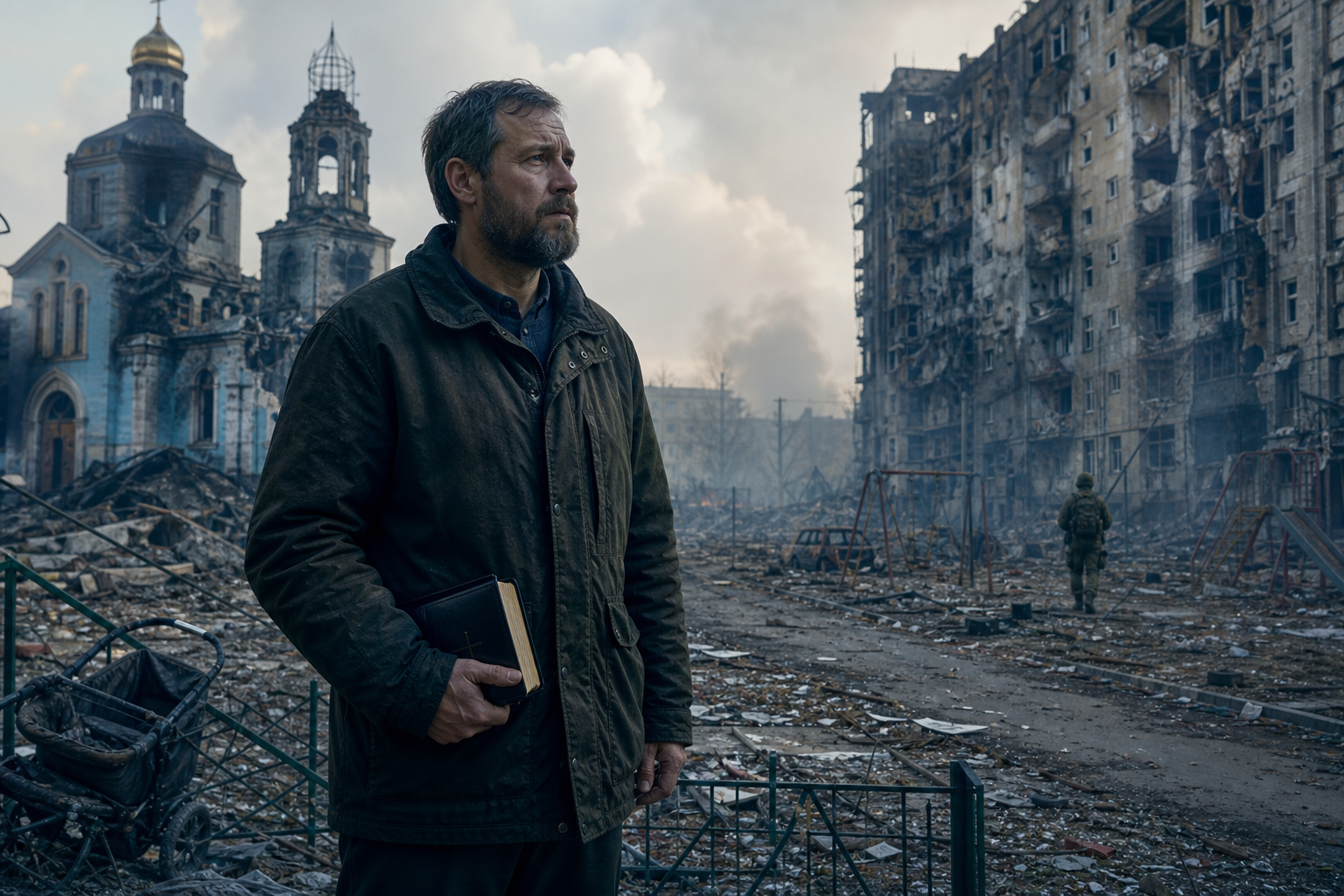
#BeingHuman. “Love Your Enemies”? No verse of Scripture is quoted to Ukrainian Christians more often, by well-meaning believers abroad and by the russian-speaking “Slavic” communities, than the command of Jesus in Matthew 5:44: “Love your enemies and pray for those who persecute you.” It arrives in our inboxes and messaging apps, in Facebook comments and in conversations, as though it were self-evidently an argument for laying down the arms with which Ukrainians defend ourselves, for muting our grief so as not to wound the feelings of russian Christians, for granting our attacker the moral standing of a fellow seeker after peace even as it asks us to submit our people to inhuman russian occupation, for treating an invasion as a quarrel between two reasonable parties, as though Abel and Cain shared the guilt equally for their alleged “conflict.”
But the command assumes a symmetry the russian war of terror has broken. If we are the enemy, then somewhere there is a “brother” (russians often call Ukrainians “a brotherly people”) for whom we are the one to be loved or hated. So, in response, I want to ask the question almost no one asks: who is preaching Matthew 5:44 to the russian Christians and evangelicals? Who stands in a Moscow pulpit and tells the russian evangelical that he is commanded to love the Ukrainian his army is bombing, raping, torturing, murdering?
The answer is the unbearable part, because their own institutional churches are teaching the reverse. Each year since 2022, the russian Baptist union issues a public letter to Putin, blessing his health and mind and commending what it calls his “efforts for peace” (and it has done so since 2014, and even before). A Pentecostal chief bishop announces that, for his brotherhood, there is nothing to repent of, all of it available on their official websites and YouTube channels and open to verification. And the many who do not bless the killing aloud have chosen instead the silence of betrayal, which is not neutral, because in the presence of a victim silence always stands beside the one holding the knife. The command to love the enemy, it turns out, is enforced in one direction only: downhill, onto the wounded, and so rarely or almost never uphill onto the one who made the wound and keeps it open.
It is the real polarization, not the one the world pictures. It is not that two “Christian peoples” differ over politics. It is that a single word, “love,” has split into two languages that no longer translate. On our side, to love the enemy is pressed to mean: stop naming the wound and russian atrocities, forgive before any repentance is offered, restore the “russian-Ukrainian evangelical brotherhood” for a photograph on a stage and a romantic story of “reconciliation,” and call the result “peace, blessed peace.” On theirs, to love is performed as blessing and supplying the occupiers who “suffer and die in Ukraine,” and praying for the president’s long life and health. The same Scripture and the same vocabulary, bent to two opposite acts under one Holy Word, is the fracture, and no reconciliation laid over it will hold.
And yet we do not forget the few on their side who refuse the “script”: the russian believers who name the war a war of terror, who repent where their leaders will not, who pay for their honesty with their freedom and their safety, and often with exile. They are a small, small minority, and we know what their courage costs them, because even from Ukraine we know their names. We hold them in our prayers, we ask God to strengthen and protect them, and we wish them His support in a place where naming the truth is dangerous. They are the ones who keep the word “love” honest in the russian language, and for that reason they are, even now, our reason to hope that this fracture will not be the final word.
All of this is the diagnosis. The harder claim is the one I want to make precise, and I make it from inside a country under russian invasion since 2014 and full-scale war since 2022: the sentimental reading is not merely unfair to us; it is a misreading of the command itself. What Jesus actually said is harder and more costly than the romantic version of “reconciliation” pressed upon us.
The deepest assault of this war falls not only on the bodies of our defenders and civilians, broken by the russian occupier non-stop day and night. It falls on the soul’s capacity to keep seeing. The “Christian” ideology that justifies this invasion, the so-called “russian World,” is at its root a denial that Ukrainians (and other ethnic groups) are a real people, and indeed human beings at all. It is an imperialistic, religious, ethnic nationalism, four things in one, that baptizes our erasure, and it is precisely the kind of racist theology that sound Christian bodies worldwide have rightly named as contrary to the Gospel, the Gospel of the same Jesus who commanded us to love our enemies.
But that ideology, which dehumanizes us, also tempts us, its direct targets, to answer in kind. Russia made itself our enemy by its own choice. And the first casualty it seeks is not our territory; it is also our ability to look at a russian soldier in a trench and still confess that he is a human being.
I do not write this from above the temptation, but from inside it. It is my starting point for reflections on love for enemies. Not even the feeling of being betrayed by many (although not totally by all) from the former russian partners (and they still are justified and we are still being accused of not sufficient love for them)… Six members of our own family have been killed by russian aggression (in 2014 and since 2022), my brother Andriy among them (in July 2024), and seven more are at the front now, defending our freedom, our land, and our people with their bodies, not just souls. I repeat it because it is a matter of memory, part of a just peace, that we pray for Ukraine, our people, and our land.
So, when I say we must keep the russian human, I am not reciting a principle; I am resisting, daily, the pull to do the opposite in my heart, and I will tell you why I resist it. It would be easier to call them a swarm, a horde, a faceless evil, orcs, and with other euphemisms, because a swarm cannot be held guilty, and a horde has no name to answer at the judgment. But that easier path is precisely the one that lets the murderer off. Only a human being can be a murderer. Only a person, made in the image of God and accountable to Him, can be charged with the terror he commits; an animal or an abstraction cannot. To insist that the man who killed my brother is a human being is not to soften what he did. It is the only way to name it as a crime and not a misfortune and tragedy of sin, to hold him responsible rather than dissolving his guilt into a euphemism. I keep him human, in part, so that he cannot escape what he is answerable for. And it is also a part of the “love your enemies” – to see a human being and God’s creature in your enemy.
That confession is, I am convinced, what “love your enemies” actually requires. Not that we pretend he is not our enemy. Not that we cease to resist his violence and terror by every legitimate means, including force. But that we refuse to let him cancel, in our own eyes, the dignity that also belongs to him as a creature of God and that his own actions cannot revoke. To love an enemy in wartime is to keep him human in your sight even as you stop him by force to defend your freedom, family, land, people. This is the love Bonhoeffer practiced when he conspired against a Nazi regime he also prayed for.
There is a strange habit, too, in how the command is aimed. When a Ukrainian speaks, the verse arrives almost at once. It comes quickly, often as the first word offered to those in grief, and almost never as the first word offered to the russian who caused the grief. Some quarters of the global Christian conscience still reach for “love your enemies” before they reach for the victim standing in front of them, as though the Ukrainian widow or mother or child at the fresh grave were a problem of insufficient forgiveness rather than a person to be wept with. The order is reversed. Before anyone instructs the bereaved mother on loving the man who killed her son, someone should first sit with her and let her weep, naming exactly what was done to her child as murder and not just as misfortune of sin.
Scripture does command us to love our enemies, and we carry that command. But it is not a tool for hurrying the wounded past their wound, and when it is used to silence the Ukrainian victims of Russia’s war of terror rather than to convict the ones waging it, it has stopped being the word of Christ and become an instrument against the very people Christ stands beside.
Here, everything hinges on a distinction that the global Church still frequently overlooks (from my observations in its public domain and narratives). To affirm an enemy’s dignity is not to affirm or hide moral equivalence between him and his victim for the sake of peace. The image of God in a man is ontological; it is a fact about his being. The justice of his cause is a separate matter entirely; it is a fact about his actions. Otherwise, why would you call the police if you are raped or robbed? Better surrender and love and refuse to go to a court for any violence, to be consistent with such an interpretation of love for the enemy. A russian conscript and a Ukrainian defender are equal in dignity and wholly, wholly unequal in the moral standing of what they are doing. And it is not about who is holier, and who is less holy. But when believers collapse these two truths into one, reasoning that because “all are sinners,” therefore “all sides suffer and must be the same,” they have not risen above what they still call “the conflict.” They have abandoned the victim of this war of terror and called the abandonment peacemaking. They abandoned Abel and called it peacemaking, because the feelings of Cain matter. Dignity without equivalence: it is the narrow path, and the only honest one.
Loving the enemy also does not mean silencing lament. The Psalms the Church has prayed for some three thousand years are full of grief that names its cause and anger that asks God for justice. We are not more spiritual than David when we suppress our cry; we are only less honest. A peace that requires the bereaved to skip their lament and proceed directly to forgiveness is not the peace of Christ. It is a second violence, dressed in evangelical language of peacemaking. The freedom to lament, to be angry at evil, to ask God how long this will be permitted, to grieve on no one’s schedule but our own, is not a failure of love for the enemy. It is part of what keeps us human while we resist him.
We are slow to say the next thing plainly, so I will: to stop the aggressor is itself a form of loving him. When God set a limit on Cain, marking him so that the killing would not simply continue, that limit was not the opposite of mercy but its instrument. There is a love that consoles, and there is a love that intervenes, placing its body between the raised hand and the one cowering beneath it, refusing to let a man complete the evil he has begun. To stand unarmed and watching while a brother is murdered is not gentleness; it is the abandonment of two people at once, the one being killed and the one being permitted to become a killer. Sin is not only suffered by its victim. It first deforms the one who commits it, hollowing the image of God in him blow by blow, and to halt that hand is to refuse him the final ruin of his own soul. So, when Ukrainian Christians defend their families, land, freedom and people from Russia’s war of terror, rape, looting, murder, torture, when they stop the occupier at the cost of everything, it is not the suspension of the command to love the enemy. It is one of its hardest forms. We love the wounded by sheltering them. We love the aggressor, strange as it sounds, at the grave’s edge of my brother Andriy, by denying him the unimpeded freedom to go on destroying, his victims and himself together, including the family of the occupier and murderer.
Love that will not protect your family and neighbor from rape, looting, murder, torture is not love; it is only the wish to keep one’s own hands clean while another’s blood soaks the snow or grass nearby…
So, what do Ukrainian Christians at war have to offer the worldwide body of Christ on the question of peace? Not a model of serene detachment; we have none to give. What we can offer is a discipline: the daily, difficult refusal to dehumanize anyone, including the one who is killing us, held together with the equally firm refusal to call his injustice justice or to mistake his erasure of us for a disagreement between equals. We hold to the first for our own sake, and for the sake of the justice and the just peace Ukraine and Ukrainian Christians long for. To remain human under these conditions is itself a confession of faith. It is what it means, in our context, to be a peacemaker who has not first become a liar. I want to repeat: to be a peacemaker who has not first become a liar…
This, I think, is what genuine non-politicized Christian witness must mean. Not neutrality between the wronged and the wrongdoer, which is itself also a political act on the side of the strong, but the refusal to let war strip the image of God from any face, our enemy’s or our own… Peace be with you, and keep your children away from war. Taras D, Ukraine

Leave a Reply